FOMALHAUT (Alpha Piscis Austrini). This wonderful first magnitude star of northern-hemisphere autumn, usually pronounced "fo-ma-low," slides slowly in lonely grandeur above the southern horizon (as seen from the north) during the months of October and November. From the southern hemisphere, it's a glory, passing overhead at 30 degrees south latitude. Well to the south of the Great Square of Pegasus, Fomalhaut marks for us the otherwise dim constellation Piscis Austrinus, the Southern Fish, not surprisingly also south of the more well-known zodiacal constellation Pisces, the Fishes. The Alpha star of the constellation, the name comes from an Arabic phrase meaning "the mouth of the southern fish." It at first seems like yet another ordinary white "class A" star similar to, though a bit cooler than, Vega in Lyra (which passes nearly overhead in temperate latitudes) with a surface temperature of about 8500 Kelvin. It is quite close, only 25 light years away, from which we calculate a luminosity 16 times greater than the Sun. Almost the same distance as Vega, it is over a full magnitude fainter to the eye as a result of somewhat lower mass of 2.0 solar, which results in a lower surface temperature and smaller size of 1.8 times that of the Sun (a figure supported by measuring the angular diameter). A equatorial spin rate of 102 kilometers per second leads to a rotation period of a day, double that of Vega. In 1983 an orbiting satellite called IRAS discovered far more infrared radiation coming from the star than expected. Infrared -- radiation which has waves longer than red light -- is a signature of a cool source. The radiation is coming from a huge disk of matter four times the dimension of our planetary system that surrounds the star much like those that encompass Vega and Denebola. The disk is thought to be made of icy dust particles that have been warmed by the star. The planets of our Solar System almost certainly formed from the accumulation of dust in just such a disk.

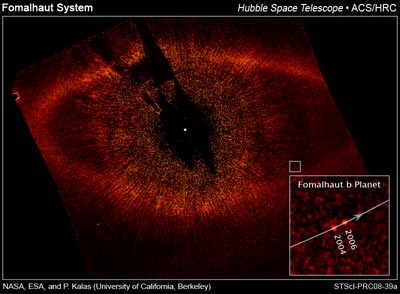
The Planet. Observation of Fomalhaut's disk shows a hole in the middle. Could the hole be the result of planets that have removed the dust? So far none have been detected within the hole. But in a stunning discovery announced in November of 2008, one was found by direct imaging to be orbiting within the disk.
Fomalhaut Fomalhaut has long been known to be surrounded by a "debris disk" that implied a planetary system. The star itself is at the center, but is blocked out so that the faint surrounding matter can be seen. The planet, among the first ever directly imaged, is within the box at lower right. (The others belong to HR 8799.) A magnified view shows a superposition of two images that reveals orbital motion. Hubble Space Telescope image: NASA, ESA, P. Kalas, J. Graham, E. Chiang, E. Kite (U. Cal. Berkeley), M. Clampin (NASA Goddard), M. Fitzgerald (Lawrence Livermore Nat'l Lab), and K. Stapelfeldt and J. Krist (NASA JPL).
With a mass of under 3 Jupiters, it lies at a huge distance of more than 115 Astronomical Units from its parent star and has an orbital period estimated at around 875 years, the greatest so far found. A modest eccentricity causes the distance to change by about 10 percent. As in our own System, the planet's orbital plane seems to be aligned with the equator of the spinning star. Along with the planets of HR 8799 Pegasi, Fomalhaut's planet has the honor of being the first to be directly seen.
Written by Jim Kaler 10/09/98; revised 11/14/08, 05/23/09. Return to STARS.