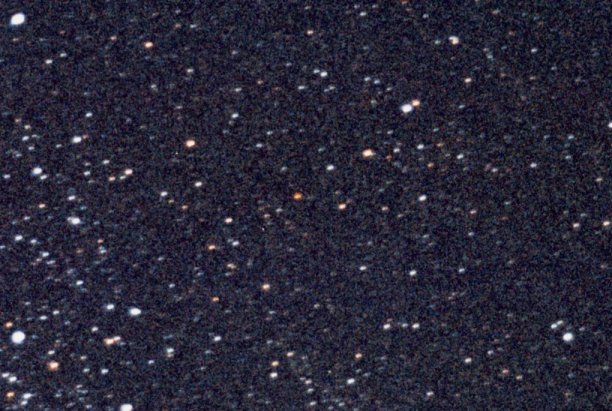
W ORI (W Orionis). The brighter stars carry proper names, or are
designated by Greek letters (Betelgeuse in Orion being Alpha Orionis) or by Flamsteed numbers (Betelgeuse
also 58 Orionis). Fainter stars get catalogue numbers. Variables, however, fall into
a special group. Unless they already have traditional names, they
are given letters from the Roman alphabet, beginning with "R" for
the first discovered, and then moving to Z, and then going through
a complex pattern of double letters. W Orionis is thus the sixth
variable (excluding those with other names, including Betelgeuse)
discovered within the constellation of Orion. Reaching sixth magnitude (5.88) at its
brightest, it also has the distinction of being one of the few
naked eye (though just barely) "class C" carbon stars in the sky. The
solar gases contain more oxygen than carbon. In an advanced
evolutionary state, carbon stars reverse the ratio by dredging
carbon that they have made in their nuclear-burning interiors to
the surface. The carbon forms molecules that block blue light,
making carbon stars among the reddest of the sky. At a large
distance of 700 light years, W Ori (a class C6 or C5 bright giant)
is actually quite luminous. Exactly how bright is argued since the
temperature (as is the case with many carbon stars) is not secure,
estimates ranging from a very cool 2600 to 3200 Kelvin. At the
lower end, the star would radiate 9400 solar luminosities (most in
the infrared) and would have a very large radius of two
Astronomical Units (AU), that is, double the distance between Earth
and Sun. Direct measure of angular
diameter, however, yields a radius of "only" one AU. That and the
higher temperature give a luminosity of 4600 solar, which is
probably closer to the truth. "W" is classified as a pulsating
semi-regular variable in which the star changes its radius as well
as its temperature and luminosity. Most such stars, however, have
a more or less regular variation period, W Ori's measured between
186 and 212 days, during which time it goes from sixth to below
naked eye visibility and back. (The variation in the infrared,
where the star emits most of its energy, is much less). W's
average brightness also changes over a much longer period of 2450
days (6.7 years) as result of either a secondary pulsation cycle or
the effect of an otherwise undetected orbiting companion. The
star, whose uncertain mass is somewhere around double that of the
Sun, is slowly brightening with a dead carbon and oxygen core. Now
losing mass at a rate of a tenth of a millionth of a solar mass per
year, the star will before long remove its vast outer envelope as
it prepares to become a white
dwarf. Its internally manufactured carbon will add to the carbon content of
interstellar space, where it will someday find its way into other
stars and perhaps other earths.