NGC 6720
THE RING NEBULA IN LYRA
MESSIER 57
The Ring Nebula in Lyra is
perhaps the classic planetary nebula. Curtis
calls it "well known and remarkably complex." The term, which
simply means "disk-like," comes from William Herschel. The Ring
Nebula was found in 1779 before Herschel announced his discovery
of the first of his "planetary nebulae" (NGC
7009) in 1785, and was added to the class later.
Planetary nebulae are the compressed ejecta of dying stars
as they turn from giants into
white dwarfs.
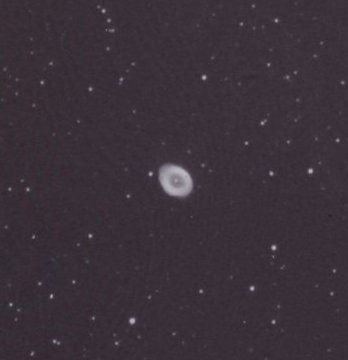
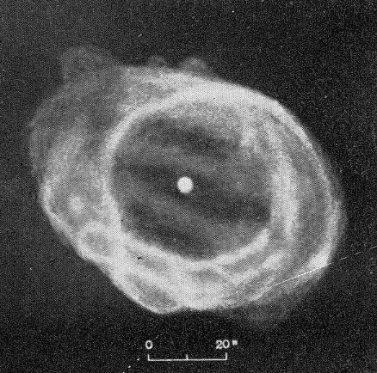
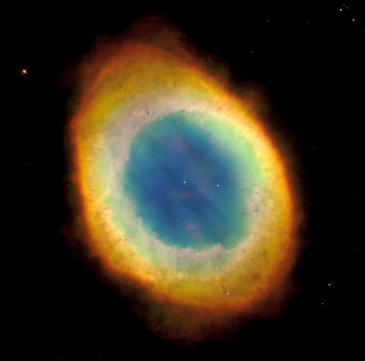
The photograph on the left gives a good sense of how the Ring
looks in a small telescope (minus the central star, which is quite
difficult to see). The image in the middle is Curtis's composite
drawing made from several photographs, while that on the right is
the Hubble view. The Ring is easily found between Beta and Gamma Lyrae.
The distance of the Ring Nebula is measured by direct parallax to be 2300 light
years away (accurate to about 40 percent). The angular dimensions
of this elliptical object of 86 X 62 seconds of arc (a "second"
1/3600 of a degree) translate to true dimensions of 0.95 X 0.7
light years. The long axis would therefore stretch 20 percent of
the way from the Sun to Alpha Centauri. The nebula, expanding
at a rate of about 30 kilometers per second, is illuminated by the
ultraviolet light of the 16th
magnitude (15.7) star at the center, which is now a cooling, but
still very hot, nascent white dwarf with a temperature of about
150,000 Kelvin and a luminosity some 500 times that of the Sun.
It looks faint only because most of its light is radiated in the
ultraviolet. Outer shells produced by mass loss in the giant star
that created the nebula extend out almost twice as far as seen
here, making the whole system nearly two light years
across.
On the right is the spectacular Hubble view. The layered
colors reveal radiation from different chemical elements in different
stages of ionization, blue from
ionized helium, yellow-green from doubly-ionized oxygen, red from
ionized nitrogen (see the spectrum below). The central star is
barely visible at the center. We might be looking down the mouth
of a barrel, or more likely the throat of an hour glass. The
structure may be similar to that of the Dumbbell Nebula, just seen from a different
perspective.
 |
As discovered by Sir William Huggins in 1864 when he
examined NGC 6543 with his spectroscope
(visually; there was no photography), planetary nebulae radiate emission line spectra. Each kind
of atom or ion will radiate at one
or more particular wavelengths depending upon the atomic
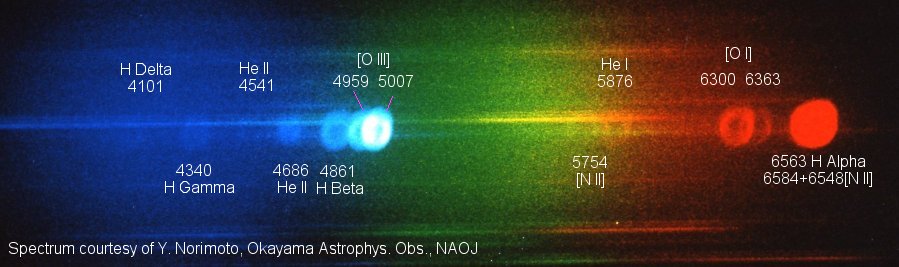
structure. In the spectrogram above, the light from the Ring
Nebula has been passed into a spectrograph that has no
spatially defining slit or aperture. Each emission line therefore
produces a picture of the nebula in the light of its associated
atom or ion. The above slitless spectrogram runs nearly
the entire length of the spectrum visible to the human eye. Each
emission is labelled with its ion and the emission wavelength in
Angstroms. The major problem with slitless spectrograms is that
the atomic/ionic images overlap one another. A longer exposure,
which would require a defining slit or small aperture to isolate a
portion of the nebula, would reveal with clarity many more lines,
as illustrated by the modern digital spectrum of BV-1.
At far right is a blend of the Hydrogen-Alpha line (the
first and strongest line of the hydrogen Balmer series) and
a pair of forbidden lines (indicated by brackets) of singly
ionized nitrogen, [N II]. They are clearly separated in the
spectrum of BV-1, which used a
narrow slit to admit the light into the spectrograph. Forbidden
lines are not really "forbidden," just unlikely in a laboratory
setting; in the low density nebulae they can reach great strength.
Going from right to left, we see the next three members of the
Balmer series, Hydrogen Beta, Gamma, and Delta, the latter glowing
faintly in the far violet. The brightest emissions are the
forbidden lines of doubly ionized oxygen ([O III]) at 5007 and
4959 Angstroms. These, along with hydrogen-beta, were the
emissions seen by Huggins that proved nebulae to be gaseous. The
oxygen lines were not actually identified as such until 1928.
Ions are produced when atoms are hit with the energetic light from
the central star, which then creates a sea of free ejected
electrons. The lines of hydrogen are produced by the
recombination of electrons with hydrogen ions (protons), those of
He I by the recombination of electrons with ionized helium ions,
those of He II by the recombination of electrons with doubly
ionized helium ions. Forbidden lines are created by the
collisions of electrons with atoms or ions.
As seen in the Hubble image, different lines have
different structures. The blue He II line (from ionized helium)
at 4686 Angstroms concentrates around the hot central star, where
energies are highest, whereas the neutral helium line at 5876
Angstroms, and especially the red neutral oxygen [O I] lines at
6363 and 6300 Angstroms, which take much less energy to produce,
are formed in an outer ring far from the star where stellar
energies are lower. The effect, called stratification, is
also seen in the Hubble image. The spectrum extends to the right
into the infrared, and to
the left into the ultraviolet. The horizontal streaks are the
spectra of unrelated stars that happen to fall within the field of
view.
The spectrum provides the means for the calculation of
nebular parameters and chemical composition. The temperature of
the radiating gas is sensitive to the ratio of the strength of the
[N II] line at 5754 Angstroms to the strengths of those near H-
Alpha. We can also use the strength of the 4363 line of [O III]
(buried in H-Gamma and unlabelled, but seen in the spectrum of BV-1) to the strengths of the
oxygen lines near H-Beta. Other line ratios (for example that of
the [O II] lines at 3726 and 3729 Angstroms, which are blended
even for BV-1) are sensitive to density. Atomic theory applied to
the strength-ratios of lines from different ions then leads to the
abundances of various elements relative to hydrogen. Planetary
nebulae are commonly enriched in helium, nitrogen, and carbon as a
result of nuclear processes that took place in the parent evolving
star, and thus provide a means for testing theories of stellar
evolution and element creation.
Left image: University of Illinois Prairie Observatory. Middle
image and quote by H. D. Curtis from Publications of the Lick
Observatory, Volume 13, Part III, 1918. Right image: The Hubble
Heritage Team (AURA/STScI/NASA). Spectrum: Y. Norimoto, Okayama
Astrophysical Observatory, NAOJ.