|
|
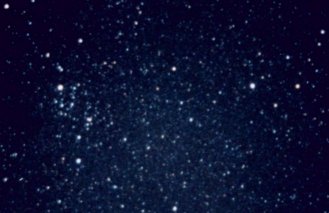
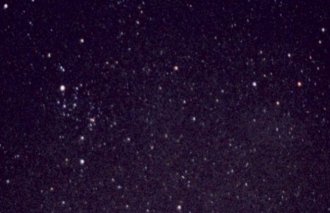
| The brightest star on the left-hand side of each picture is Mirfak, Alpha Persei, while the brightest on the right-hand side is Algol, Beta Per. In the reference picture at left, Algol is in its uneclipsed state and nearly as bright at Mirfak. In picture at right, taken the night of October 9, 2004, Algol is in mid-eclipse, and notably dimmed. Compare with other stars in the field as well. The star immediately to the right of Algol, Rho Persei is also variable. See full full resolution. Copyright J. B. Kaler. | |
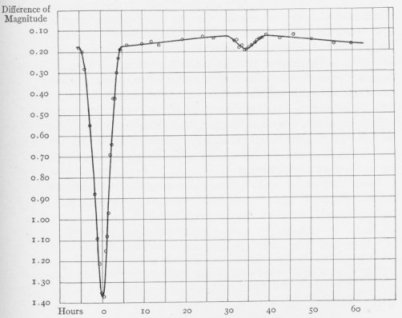 The eclipses of Algol were first accurately recorded
photoelectrically around 1910 with the historic 12-inch refractor
at the University of Illinois Observatory. The magnitude scale
does not reflect actual visual magnitudes. The primary eclipse at
left occurs when the bright class B star partially hides behind the
cool K star. The brightness of the system then changes slightly
out of eclipse because of the tidal distortion of the stars and the
reflection of the B star's light from the K star. Thirty hours
after the primary eclipse, the smaller B star passes in front of
the K star and cuts out a portion of its light to create the
secondary eclipse at center. Light curve by Joel Stebbins in the
Astrophysical Journal, vol. 32, p. 185, 1910.
The eclipses of Algol were first accurately recorded
photoelectrically around 1910 with the historic 12-inch refractor
at the University of Illinois Observatory. The magnitude scale
does not reflect actual visual magnitudes. The primary eclipse at
left occurs when the bright class B star partially hides behind the
cool K star. The brightness of the system then changes slightly
out of eclipse because of the tidal distortion of the stars and the
reflection of the B star's light from the K star. Thirty hours
after the primary eclipse, the smaller B star passes in front of
the K star and cuts out a portion of its light to create the
secondary eclipse at center. Light curve by Joel Stebbins in the
Astrophysical Journal, vol. 32, p. 185, 1910.
|